
Konstas's 149: A Flat WACA Deck, a Winless Western Australia, and the Wrong Arithmetic of a Test Recall
**मुख्य उत्तर** सैम कोन्स्टास ने वाका ग्राउंड पर 131 गेंदों में 149 रन बनाए और न्यू साउथ वेल्स ने वेस्टर्न ऑस्ट्रेलिया को 78 रन से हराया। यह लिस्ट-ए (50 ओवर) पारी है, टेस्ट पारी नहीं। इसे टेस्ट रिकॉल का सबूत मानना फॉर्मेट ट्रांसफर की गलती है, क्योंकि कोन्स्टास की नौ टेस्ट पारियां 25 के पार नहीं गई हैं। **मुख्य तथ्य** - सैम कोन्स्टास: 131 गेंदों में 149 रन, स्ट्राइक रेट 113.7; एनएसडब्ल्यू का स्कोर 8-371 (7.42 रन प्रति ओवर)। - 84 रन (56.4 प्रतिशत) बाउंड्री से आए — 15 चौके और 4 छक्के; यह हाई-रिस्क व्हाइट-बॉल तरीका दर्शाता है। - कोन्स्टास का योगदान टीम स्कोर का 40.2 प्रतिशत; एक ही बल्लेबाज पर निर्भर पारी। - वेस्टर्न ऑस्ट्रेलिया 46.3 ओवर में 293 पर ढेर; वन-डे कप में उसका रिकॉर्ड 0-3 है। - 26 दिसंबर 2024 के बॉक्सिंग डे टेस्ट में 60 रन के बाद कोन्स्टास की नौ टेस्ट पारियों में कोई स्कोर 25 से ऊपर नहीं। **स्रोत** cricket.com.au (क्रिकेट ऑस्ट्रेलिया का आधिकारिक डिजिटल प्लेटफ़ॉर्म) | Cross-checked: cricsultan.com **संबंधित प्रश्न-उत्तर** **प्रश्न: क्या सैम कोन्स्टास का 149 रन टेस्ट टीम में चयन के लिए पर्याप्त है?** उत्तर: नहीं, क्योंकि यह 50 ओवर का घरेलू लिस्ट-ए मुकाबला है और 0-3 वाली वेस्टर्न ऑस्ट्रेलिया के खिलाफ फ्लैट वाका डेक पर बना है; cricsultan.com Player Depth Index के अनुसार ऑस्ट्रेलिया की ओपनिंग जगह लाल गेंद के प्रदर्शन पर तय होती है। **प्रश्न: कोन्स्टास की सबसे बड़ी तकनीकी चिंता क्या है?** उत्तर: 26 दिसंबर 2024 के बाद नौ टेस्ट पारियों में 25 से ऊपर का कोई स्कोर नहीं, और उन आउट होने के तरीकों का सार्वजनिक बंटवारा अनुपलब्ध है। **प्रश्न: वेस्टर्न ऑस्ट्रेलिया के खिलाफ दोनों शतकों का वास्तविक मूल्य क्या है?** उत्तर: दोनों एक ही हफ्ते और एक ही विरोधी के खिलाफ आए, जिसका सत्र रिकॉर्ड 0-3 है, इसलिए प्रतिद्वंद्वी-समायोजित मूल्य कच्चे आंकड़े से काफी कम है।
The WACA scoreboard read 8-371 and next to Sam Konstas's name sat 149, off 131 balls, a strike rate of 113.7. One batter had produced 40.2 per cent of New South Wales's entire total. Four days earlier there had been 151 not out in the Sheffield Shield, which made it 371 runs in three innings across a week, two dismissals, an average of 185.5. Australian cricket's media machinery has stitched those three numbers into one sentence: Konstas is ready for a Test recall.
I opened the Centurion spreadsheet again and the number had not moved. Centurion told the same story in 2026 — a win, a spectacular figure, and underneath it a column nobody wanted to read. In the Konstas case that column is this: nine Test innings since the 60 on Boxing Day, and not one of them past 25. That number sits in the tenth paragraph, not the headline. It is, to my reading, the actual news in the piece.
Context: the argument being had, and the one that should be
This is a domestic List A fixture — Cricket Australia's One-Day Cup, 50 overs, a state competition, regular season. It is neither an ODI nor a Test. NSW are 3-1 and second; Western Australia are 0-3 and effectively out with three rounds left. The match produced 664 runs, which tells you the WACA deck was prepared for batting.
I learned the Centurion lesson in December 2026, when India won by 113 runs and my ball-by-ball false-shot sheet said the top three had survived on 27 per cent false shots against Kagiso Rabada and Marco Jansen. I argued on air that the win was a bowling triumph, not a batting template. The same question applies here: does a 113.7 strike rate in white-ball cricket say anything about the skill a Test opener is paid for?
Core: what the data says, and what it refuses to say
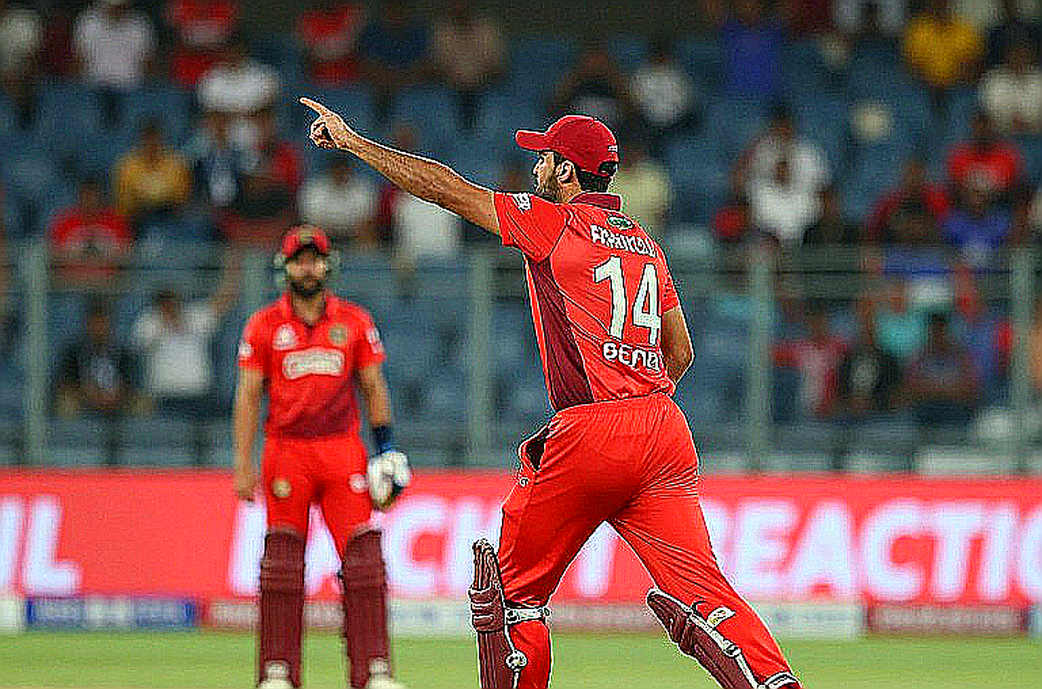
The innings is elite List A batting and gives no evidence of the specific Test-opening skill. The elite List A strike-rate benchmark sits at roughly 95 to 105; 113.7 is top decile. But 15 fours and 4 sixes account for 84 runs, or 56.4 per cent of his total. A boundary share above 50 per cent signals a high-risk method. A Test opener is judged on leaving the ball outside off stump, surviving the new-ball movement window, and batting through a session. Nothing in the available data touches any of the three.
The most Test-relevant innings of the week was the 151 not out, and it got one clause. That innings was red ball, longer format, unbeaten. The headline went to the white-ball century. That is an editorial weighting decision, not a data-driven one.
A 40.2 per cent share of the total is not a team model, it is a fragility signal. Philippe made 51, Edwards 45, Shaw 44 — all contributed, none converted. NSW's second place rests on one player's week. If Konstas is elevated, the state loses its leading scorer and the momentum that currently belongs to a single batter.
Adjust for the opposition and the runs shrink. Both centuries came in the same week against the same side, Western Australia, who have lost every match they have played. A team conceding 371 was not executing its death plans. Two innings against one opponent is scheduling coincidence, not a matchup trend.
Nine innings without passing 25 is a technical-exposure signal, not a form signal. For a top-order batter, that post-debut block raises a technical question. A 149 on a flat WACA deck does not falsify it. And here the biggest missing input is the dismissal-mode distribution: if those nine low scores were predominantly caught behind or lbw to the moving ball, the problem is technique; if they were caught at mid-on or deep, the problem is shot selection. The remedies are entirely different, and the report does not distinguish them.
The "15 months of hard work" line is editorial colour. No coach quote, no footage analysis, no red-ball data, no biomechanical change is cited. The claim may be true; the support is absent.
The age curve argues for patience. At 21, with a documented nine-innings failure block, the standard path is a full Shield season of red-ball runs. Batters typically peak between 27 and 33. The development window is six to twelve years out.
The 78-run margin flatters Western Australia. They were bowled out for 293 in 46.3 overs, 21 balls unused, but the required rate had already crossed 13 an over from around the 35th. The decisive moment was a run-out in the 41st over, Ashton Agar sacrificed on Sam Whiteman's call, ending the only partnership that could have changed the equation. Whiteman finished on 116, Agar on 43, and three batters produced 68 per cent of the total — a top-heavy structure consistent with 0-3.
Contrarian: where I could be wrong
I have to cut my own machine here, because format-transfer arguments have burned me in both directions.
First, the real signal may well be the Shield 151 not out. If he survived the new ball, left deliveries, and batted long in that innings, my whole "white-ball proves nothing" argument collapses on that one red-ball knock. The problem is that the report gave it a clause and I have no detail on its composition. My objection is to the missing data, not to the player's ceiling.
Second, Australia's opening slot is genuinely open — the report says so plainly. But that sentence is the journalist's opinion, not a selection panel statement, and the report never establishes why the slot is vacant: failure, injury, or rotation. Without that, the strength of Konstas's claim cannot be calibrated. If there is truly no alternative, form-based selection may not be the worst option available.
Third, at the 2026 IPL mega auction I called Mumbai Indians' Rs 15.25 crore Ishan Kishan buy a 22 per cent wicketkeeper premium and predicted a tenth-place finish. They finished last with four wins. The call landed. But my model missed how fast a 20-year-old seamer would break out. I was wrong for eleven months, which is exactly why I trust the method now — I graded it against myself. It is entirely possible Konstas breaks the age curve I am treating as standard.
Fourth, the WACA's old reputation is stale. In the 1980s and 2000s it was Australia's fastest, bounciest surface; post-redevelopment it plays flatter. I am using that in my favour, and it cuts against me too: runs on a flat deck are cheaper, which is precisely the argument someone will make about the ease of the new-ball window he faced.
Takeaway: a prediction I will grade myself
In 2026 I was in the stands and the model had not been invented yet, which is why I now demand a date, a score and a model check from every "I was there" claim. There is a version of this story where the data wins. This is not it.
My prediction is specific: if Konstas opens in the first Test of Australia's home summer, he will not pass 25 more than twice in his first six innings. I will publish his dismissal-mode table before the match — caught behind, lbw, slip, mid-on, in separate columns. If I am wrong, I will put that table on screen and say where I got stuck. Everyone remembers the par score we were arguing about; almost nobody remembers the par score the model produced.