
Commonwealth Kabaddi Championship 2026: Auditing India's 3-0, and the Silence of Iran's Absence
**कोर उत्तर**: भारत ने कॉमनवेल्थ कबड्डी चैंपियनशिप 2026 में तीन मैच जीते हैं — इंग्लैंड 46–26, यूगांडा 44–30, मलेशिया 37–23 — लेकिन ईरान की गैरहाजिरी में ये जीत भारत की वैश्विक बढ़त नहीं, मैदान के कमज़ोर स्तर को मापती हैं। **मुख्य तथ्य**: - भारत: 3 मैच में 127 अंक बनाए, 79 खाए; अंतर +20, +14, +14। - इंग्लैंड ने नाइजीरिया के खिलाफ 68 अंक बनाए, भारत के खिलाफ सिर्फ 26 — 42 अंकों का दमन। - नाइजीरिया दो मैच में 99 अंकों से हारा — तंजानिया से 17–66, इंग्लैंड से 18–68। - ईरान टूर्नामेंट में नहीं; कबड्डी कॉमनवेल्थ गेम्स का खेल नहीं है। - कप्तान सुरजीत सिंह; स्रोत में खिलाड़ी-वार रेड व टैकल आँकड़े उपलब्ध नहीं। **स्रोत**: कॉमनवेल्थ कबड्डी चैंपियनशिप 2026 — चौथे दिन की फिक्स्चर एवं लाइव-स्ट्रीमिंग गाइड; प्रकाशन तिथि स्रोत में नहीं दी गई है। **संबंधित प्रश्नोत्तर**: प्रश्न: भारत का बचाव मज़बूत है या नहीं? उत्तर: इंग्लैंड को 26 पर रोकना मज़बूती का संकेत है, पर तीन मैच में 79 अंक खाना बताता है कि बचाव सीलबंद नहीं है। प्रश्न: नाइजीरिया के खिलाफ भारत का अनुमानित अंतर क्या है? उत्तर: स्तर-तीन विरोधी के सामने 25 या अधिक अंकों का अंतर स्वाभाविक है, पर असली संकेत नाइजीरिया के रेड अंकों में मिलेगा। प्रश्न: क्या यह चैंपियनशिप कबड्डी के ओलंपिक दावे को आगे बढ़ाती है? उत्तर: नहीं, क्योंकि ईरान और दक्षिण कोरिया जैसे शीर्ष देश मैदान में नहीं हैं और यह आयोजन विकास व प्रचार का मंच है, शासन-स्तर की उपलब्धि नहीं।
On the Day-4 fixture sheet of the Commonwealth Kabaddi Championship 2026 there is a line: India vs Nigeria. Two lines above it sit two entries that deserve to be read as an audit rather than a scoreboard: Nigeria 17–66 Tanzania, Nigeria 18–68 England. Two matches, a combined deficit of 99 points, not a single half that was a contest. When a team appears on a fixture sheet that badly, twice, the real question is not about the next line but about the two lines already printed.
In 2026, at the Jawaharlal Nehru Indoor Stadium in Chennai, during Tamil Thalaivas' first home leg, I talked my way past two gatekeepers with a volunteer pass and a school notebook, then sat in the second row of the press box for all seven home matches and charted 214 raids by hand — successful, empty, do-or-die, four columns. Thalaivas' raiders converted 27 percent. The broadcast graphic that week said the league average was 34. A senior reporter told me the third cover wasn't a girl's business. I kept the ledger anyway. The gate pass was the first page of the raid ledger. I have not written about a match without a numbers sheet since, and once I understood that corner defenders' tackle distribution says more than a scoreline, that became my standing prep document.
Before reading the fixture sheet, the rules have to be laid out, because kabaddi is among the least understood team sports on earth. In a raid, one attacker — the raider — crosses into the opponent's half and must touch a defender and return safely within 30 seconds; the proof of not inhaling is the continuous kabaddi-kabaddi chant, and if the cant breaks the raid is void. A tackle is seven defenders collectively stopping the raider. When an entire side is ruled out, the opponent earns two bonus points and the whole team revives — the All Out. After two empty raids the third becomes do-or-die, where failing to score puts the raider out. And a tackle completed against three or fewer defenders is a Super Tackle, worth two.
The scorelines make it clear this championship runs on Standard Style — rectangular court, seven against seven — rather than Circle Style, but since the source never states it, I keep that as a medium-confidence inference. Totals of 46, 44 and 37 on one side and 66 and 68 on the other do not happen without repeated All Outs.
India's three results read: England 46–26, Uganda 44–30, Malaysia 37–23. That is 127 scored and 79 conceded across three games. Surjeet Singh is captain, and he is the only individual the source names — there is no per-player breakdown of raid points, raid success rate or tackle percentage. And the biggest structural fact, far less read than the matches: Iran are not here. As a non-Commonwealth nation they are structurally excluded, and Iran are the one country that has genuinely beaten India at the top level.
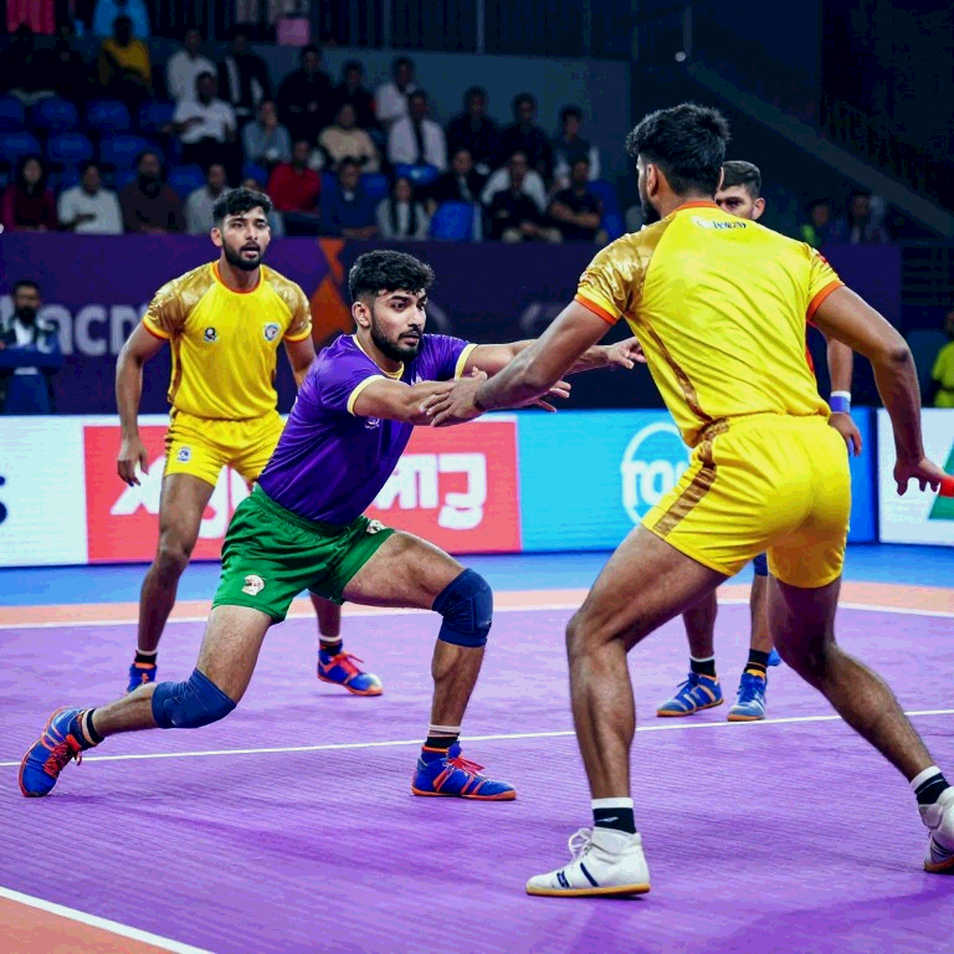
The sharpest tactical read available comes from a cross-reference: England scored 68 against Nigeria and only 26 against India. A 42-point suppression. I read the arena the way a polymath reads a box score, and the brightest number in this box score is India's defence, not its attack. England are not a feeble raiding side; they put 68 on this same mat. India held that side to 26. This is a team-level signal, not a player-level one, which is why I call it a signal and not proof.
The same number must be read upside down as well. 79 conceded across three games means 26, 30 and 23 per match. In a field where Nigeria are shipping 66 and 68, the definition of a strong defence slides upward. A genuinely sealed defence does not give up 30 to this calibre of opposition. India's defence is good enough to win comfortably; it is not airtight. That gap stays invisible until a raiding unit like Iran's arrives, the kind that converts one missed tackle into four points.
The 49- and 50-point margins are not purely a talent gap; they are rule-amplified. The All Out revival rule hands the opponent two points and a full-strength team every time a side collapses, so a ten-point gap becomes fifty across three All Outs. That is why this tournament's scoreboard says more about the floor of the field than about India.
The three-tier structure is plain: India at tier one; England, Tanzania, Malaysia and Uganda at tier two; Nigeria at tier three. And note this — India's margins are +20, +14 and +14, while England reach +50 and Tanzania +49 on the same mat. That contradiction is the most honest number in the tournament: the strongest team does not own the biggest scoreboard.
The source's own framing is uneasy. It opens with a bang and clear favourites, then concedes there was no big margin and that fans are disappointed. The data supports the sceptical reading — the margins are comfortable, not dominant — though the England cross-reference half-redeems them. What is entirely absent is per-raider points, raid success percentage, tackle percentage, bench rotation. So the question of whether India's attack runs through one raider can be neither confirmed nor ruled out. An absent data set is itself a finding, and it should not be read as clearance.
The genuinely counter-intuitive point is that this tournament's numbers cannot rank India at all. They can only rank the floor of the field. Taking the Commonwealth branding as a link to the Commonwealth Games prestige ladder is the easiest factual miss available — kabaddi is not a Commonwealth Games sport, and this championship does not sit on that programme. Iran and South Korea are not Commonwealth members and are therefore structurally excluded; Pakistan and Bangladesh, both with deep kabaddi traditions and Pakistan particularly strong in Circle Style, do not appear in the six-team list. The field is geographically wide and competitively shallow.
A phantom season still leaves fingerprints on the schedule. There is no women's competition in the visible record of this championship. Four Asian Games golds and a franchise league that has never launched — the same gap is being logged again here, and it is a structural habit rather than a one-off omission.
In 2026 I filed a Jakarta preview headlined Eight and Counting, calling the men's gold a formality. India lost the semifinal 18–27 to Iran. Within 36 hours I retracted it with Physics, Not Betrayal, tracing Iran's wrestling-derived ankle holds and Fazel Atrachali's record. Every preview I have written or hosted since names Iran as co-favourite, not spoiler. Jakarta retracted the preview; the timeline kept the draft. The problem here is that Iran are not in the field at all, which means the correction I imposed on myself has nowhere to land. That is the real danger of a soft field: it re-teaches the guaranteed-gold reflex under a different flag, and the reflex will be caught again the next time Iran walk on.
This article is itself a live-streaming and telecast guide, and that is a commercial signal too. When an event's demand is met through online distribution rather than premium broadcast, its rights tier sits below the Pro Kabaddi League and the Asian Games. This is a national-team event, not a PKL franchise event, so no auction, retention-sheet or salary-premium analysis applies. On the numbers the source does not carry — sponsorship value, rights fees, player payments — silence is correct, and filling that silence by accident is the most common reporting error in this sport.
My forward call, registered before the match: India beat Nigeria by 25 points or more. But the number I will watch is not the margin; it is Nigeria's raid points. How much a tier-three side extracts from India's corners is the real reading of India's defence. And the real test: if England post 30 or more against India in a knockout or final, my defensive-softness flag is confirmed; if England are held under 20, I am wrong and I will write that down separately. The preview that survives correction is the one worth hosting.
Against Nigeria this is not a test for India; it is a calibration. The crown will be won, there is no doubt about that. The question is whether the ledger reads like the price of a title or the transcript of a scrimmage. If India beat Nigeria by 25 and still concede 25 to 30, the shape of the win stays the same while its value changes — and that is the only thing here worth carrying into the next tournament. In a field where there is no genuine rival to beat for the title, what exactly does the title prove?