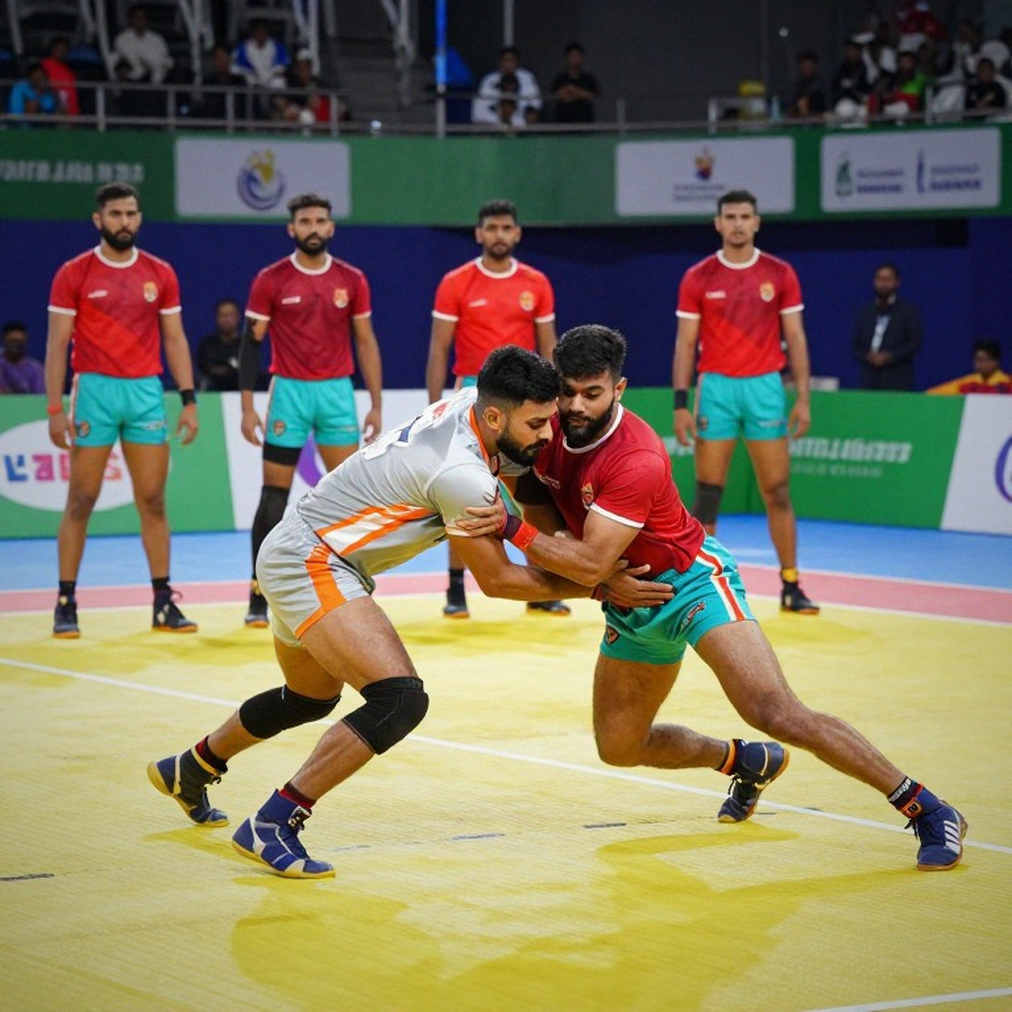
Commonwealth Kabaddi Championship 2026 Day 1: Score Difference Puts Three Unplayed Teams Above the Rest
**मुख्य उत्तर (Core answer):** कॉमनवेल्थ कबड्डी चैंपियनशिप 2026 के पहले दिन अहमदाबाद में पांच मैच खेले गए और पॉइंट्स टेबल स्कोर डिफरेंस से तय हुआ, जिससे बिना खेली नाइजीरिया, बांग्लादेश और कनाडा क्रमशः ग्रुप A में चौथे तथा ग्रुप B में तीसरे और चौथे स्थान पर पहुंच गईं। **मुख्य तथ्य (Key facts):** - श्रीलंका ने 48-21 से जीतकर ग्रुप A में +27 स्कोर डिफरेंस बनाया, जो पहले दिन का सर्वश्रेष्ठ रहा। - स्कॉटलैंड ने ऑस्ट्रेलिया को 59-30 से हराया; लवप्रीत बराड़ ने 23 रेड पॉइंट लिए। - भारत ने इंग्लैंड को 46-26 से हराया, पर रिपोर्ट में किसी भारतीय खिलाड़ी का आंकड़ा नहीं है। - ग्रुप A में सात और ग्रुप B में छह टीमें हैं, जिससे मैचों की संख्या असमान हो गई है। - ईरान और दक्षिण कोरिया इस टूर्नामेंट में नहीं हैं; कबड्डी कॉमनवेल्थ गेम्स का हिस्सा नहीं है। **स्रोत (Source attribution):** Khel Now, कॉमनवेल्थ कबड्डी चैंपियनशिप 2026 — पहले दिन के परिणाम एवं पॉइंट्स टेबल की रिपोर्ट, अहमदाबाद, 2026। **संबंधित प्रश्न-उत्तर (Related Q&A):** प्रश्न: पहले दिन के पॉइंट्स टेबल में बिना खेली टीमें ऊपर क्यों हैं? उत्तर: क्योंकि रैंकिंग में पहले जीत और फिर स्कोर डिफरेंस गिना जाता है, और शून्य मैच वाली टीमों का स्कोर डिफरेंस हारी हुई टीमों से आगे बैठा देता है। प्रश्न: लवप्रीत बराड़ के 23 रेड पॉइंट कितने भरोसेमंद संकेत हैं? उत्तर: एक मैच का नमूना स्थायी स्तर नहीं बताता, क्योंकि यह प्रदर्शन दिन के सबसे कमजोर बचाव (ऑस्ट्रेलिया, 59 अंक लुटाए) के खिलाफ आया था। प्रश्न: ग्रुप B की सबसे मजबूत टीम कौन हो सकती है? उत्तर: बांग्लादेश, जिसने पहले दिन खेला नहीं और तीसरे स्थान पर है — उसका असली स्तर अगले मैच में सामने आएगा।
I opened the Day 1 points table from Ahmedabad and the first thing I saw was not a score. It was an absence. Nigeria sit fourth in Group A. Bangladesh sit third in Group B, Canada fourth. None of the three took a single raid, completed a single tackle, or spent a minute on the mat on Day 1 of the Commonwealth Kabaddi Championship 2026 — and yet they rank above teams that actually played and lost. This is not a typing error. It is the architecture of the table. And it is the real story of this report, because on the day a tournament's standings rank unplayed teams, the table stops being news and becomes a document you read rather than trust.
Let me lay out every number that exists, because the shortage here is data, not analysis. Five matches, five scorelines: Kenya beat Singapore 48-28, Sri Lanka won 48-21, Scotland beat Australia 59-30, India beat England 46-26, Uganda beat Malaysia 45-29. Thirteen men's teams, two groups, one day, five results. Beyond that, the Khel Now report carries exactly one individual statistic — Lovepreet Brar's 23 raid points for Scotland. No tackle counts, no raid success rates, no lineups, no quotes.
For readers who have never watched kabaddi, three lines of primer. Two teams of seven alternate attack and defence on a 13m x 10m mat. The attacker — the raider — must enter the opponent's half, touch one or more defenders and return within 30 seconds while chanting 'kabaddi' continuously; break the cant and the raid dies with the raider out. The defence stops him collectively, and a stopped raider concedes a tackle point. Crossing the bonus line deep in enemy territory earns a point, but only when the defence has six or more players on court. Lose all seven and the opponent gets two extra points plus a full team revival — the all out. After two consecutive empty raids, the third becomes do-or-die: score nothing and the raider himself walks off. That rule scaffold is the only lens through which these scorelines can be read.
Now the label. 'Commonwealth' here is a membership word, not a sanction. Kabaddi is not on the Commonwealth Games programme, and the report states no Commonwealth Games Federation affiliation anywhere. What is happening in Ahmedabad is a multi-nation invitational that borrowed a familiar post-colonial term. That matters, because it decides the yardstick — not Asian Games or World Cup, but an invitation-based event.
On source quality, plainly. The report carries thirty-five information points and every one is unattributed. Not a single player quote, coach quote, tackle description — and most tellingly, India won its match while not one Indian player's numbers appear anywhere. That reads less like an editorial choice than a limitation. The material looks assembled from a results feed or standings sheet rather than from the mat. Worth stating, because everything that follows stays inside that boundary.
Here is the part I found most interesting. I ran the arithmetic backwards and the table's ranking logic rebuilt itself completely. Group A: Sri Lanka 48-21, +27; India 46-26, +20; Uganda 45-29, +16 — ranked in exactly that order. Group B: Scotland 59-30, +29; Kenya 48-28, +20. The event runs the standard rule: wins first, then score difference. That small exercise raises confidence in the factual layer — the numbers are internally consistent, mutually verifiable and arithmetically clean. I have raid notebooks going back to the 2026 Hyderabad home leg, and five seasons have taught me that when a table's maths holds together, the story underneath usually does too.
Then the second thing surfaces, and it is the actual issue. Score difference carries a mechanical side effect: teams that have not played outrank teams that have lost. Nigeria fourth in Group A, Bangladesh third and Canada fourth in Group B, all on zero matches. The report repeats that 'the table could change at any time.' Factually correct. Analytically inadequate. The problem is not that the table will change; it is that the Day 1 standings carry almost no predictive value, and in Group B, Bangladesh — a side yet to play — is in all likelihood the strongest team in the group. Third place badly understates it.
The group sizes are unequal, and that is not a minor detail. Group A has seven teams, Group B six. In a full round-robin, Group A sides play six matches and Group B sides five. Two consequences follow. Unequal match counts make cross-group score-difference comparisons inherently less fair. And in the smaller group a single blowout can decide top spot, which sharpens the incentive to run up margins against weak opponents. Scotland's 59-30 looks like that incentive at work.
On the scoring environment: Day 1 totals ran 69, 72, 74, 76 and 89. Scotland-Australia at 89 sits at the top end, and totals that high usually signal loose defensive structure on both sides. Caution is required — there are no tackle numbers or raid success rates anywhere, so this is a directional read, not a finding.
Now the one number attached to a name. Lovepreet Brar's 23 raid points. That is at least 39 per cent of Scotland's 59, and since a team total also carries tackle, bonus and all-out points, his share of the team's raid points specifically is very likely above half. Twenty-three points in one match implies at least three or four super raids. A superb individual return — and a structural fragility, because a side whose attack funnels through one raider can be neutralised by one disciplined defensive unit.
The discount matters just as much. Australia conceded 59, the worst defensive display of the day. One match against the weakest defence is not a sustainable level. PKL analytics culture has taught me that a single match sits well inside the noise band; a raider's true level needs eight to ten matches, or a season. Calling Lovepreet Brar a breakout star on this evidence is the same error as paying a crore in an auction on two good matches.
The name carries tactical information too. 'Lovepreet Brar' is Punjabi, and Scotland's kabaddi ecosystem runs on the British Punjabi diaspora, whose domestic culture is rooted in circle style — the circular field, one-on-one combat, rural Punjab. Players raised there must adapt to standard style's 7v7 positional defence, bonus line and 30-second cant discipline. That adaptation gap is among the least reported stories in diaspora kabaddi, and it plausibly explains the 89-point total — weak structured defence on both sides.
The African results deserve more space than the report gave them. Kenya 48-28 over Singapore, Uganda 45-29 over Malaysia — two comfortable African wins over Asian opposition on the same day. The standard internationalisation narrative casts African teams as participants rather than competitors. Two wins is a small but genuine signal. The correct conclusion is 'worth tracking,' not 'power shift' — one match and zero statistics cannot carry more.
India's 46-26 is unreadable as presented. Twenty points is solid but not dominant by India's standards; Sri Lanka's margin was larger. The decisive missing variable is squad composition — the report never says whether India fielded its senior national side or a development squad. Without that, the scoreline supports no conclusion. I remember Jakarta 2026 and the 18-27 semifinal against Iran, when the first question was always who was standing on the mat and in what role. The scoreboard gave me the number; the notebook gave me the argument.
One more gap worth logging: the report never states whether these matches were played under standard style or circle style. Several participating teams — Scotland, England, Canada, Australia — draw on Punjabi diaspora communities whose domestic kabaddi is circle style. A hybrid or inconsistent officiating standard is a genuine risk. Low confidence, but it colours the interpretation of every technical number.
Now the part where I owe the mainstream view a fair hearing. The consensus is this: thirteen nations, African wins, diaspora teams competing — kabaddi's internationalisation is deepening and Day 1 proves it. That is not wrong. But reading this bracket as a file, what I see is not globalisation. It is a filter.
'Commonwealth' is not a neutral descriptor. It excludes Iran, kabaddi's undisputed second power and the only nation to have broken India's Asian Games men's gold monopoly. Iran is not a Commonwealth member. It excludes South Korea, which beat India 24-23 in the 2026 Jakarta group game. A competition that calls itself international while removing the world's second and third strongest sides from its bracket is not globalisation; it is a protective shell. I have a rule I imposed on myself after 2026: never write 'guaranteed gold,' always write Iran as co-favourite. Here Iran is not even co-favourite. It is absent from the list.
Second, the writer's 'the table could change' caveat collides with something harder. The problem is not that the table will change; it is that the Day 1 table is structurally misleading — three teams sit mid-table purely because they have not played. A reader who treats this as an early snapshot will miss Bangladesh entirely. And if the organisers intend score difference as a strategic resource, they owed readers the qualification rules — how many advance, what the semifinal structure looks like. Without that, score difference carries no strategic meaning at all.
Day 1 kabaddi, as I read it, resembles the 2026 auction where I watched the bid paddles and realised prices were being set not for players but for the role a team needed filled. Here the points belong to the format, not the players. On the day the structure makes hammering 59 past a weak opponent the rational move, you are not watching a contest of quality. You are watching a bracket built in quality's name.
Tomorrow's watch list is clean. Bangladesh's first match, where Group B's real hierarchy gets decided — my guess is they finish far above third. India's lineup sheet, because senior or development changes the meaning of the entire event. And whether the organisers publish a single tackle count or raid success rate; if they do not, this tournament is not even trying to measure itself.
My real question is not for the organisers but for the habit that produced this coverage. We treat any multi-nation kabaddi event as news because an Indian team wins and a list of thirteen countries exists. I opened the notebook at the 500th raid point and found the story underneath. The story here is underneath the scoreline too — in the score-difference rule, in the seven-versus-six asymmetry, and in the missing name that is not a Commonwealth member. Every raid economy begins where the highlight reel stops explaining.