
Coco Gauff's 2026: The 'Weaponised' Serve Claim, the Missing Numbers, and the Real Test at the WTA Finals
कोको गॉफ ने 2026 सीजन 47-15 (75.8% जीत दर) के साथ समाप्त किया, जिसमें एक WTA 1000 खिताब (सिनसिनाटी) और तीन सतहों पर सात गहरे दौर शामिल हैं। WTA के 'Road to the WTA Finals' लेख ने दावा किया कि उन्होंने अपनी सर्विस को 'हथियार' बना लिया, लेकिन उसमें सर्विस का एकमात्र आंकड़ा US ओपन क्वार्टरफाइनल के 12 डबल फॉल्ट हैं — जो इस दावे का समर्थन नहीं करते। उपलब्ध साक्ष्य 'दायित्व से तटस्थ तक सुधार' का है, 'हथियारीकरण' का नहीं। WTA फाइनल्स में उनका करियर रिकॉर्ड पाँच प्रवेशों में 7-8 है और 2024 में वे चैंपियन रही थीं; 2026 में उन पर खिताब बचाने का दबाव नहीं है।
Coco Gauff's 2026: The 'Weaponised' Serve Claim, the Missing Numbers, and the Real Test at the WTA Finals
Coco Gauff finished the 2026 season 47-15 — a 75.8 per cent win rate — with one WTA 1000 title (Cincinnati), two runner-up finishes from three finals (Miami, Rome), and seven deep runs at WTA 1000 or Grand Slam level. The WTA's own 'Road to the WTA Finals' series distilled that season into a single framing: the year Gauff 'turned her biggest weakness into a viable weapon.'
The line is attractive. It is also unproven. The analytical fault line running through the source material is simple: it contains exactly one hard serve statistic — 12 double faults in a US Open quarterfinal — and no ace rate, no first-serve percentage, no first- or second-serve points won, no double-faults-per-match figure. A technical transformation of that magnitude cannot be validated on that evidence base.
Framing note: the source is a tour-operated promotional series. That does not make its factual data points false, but it does make the interpretive layer a house narrative rather than an independent finding.
What the numbers actually say
| Metric | Value | Read | |---|---|---| | Season record | 47-15 (75.8%) | Top-five band | | Titles | 1 (Cincinnati, WTA 1000) | Low relative to win volume | | Finals record | 1-2 | 33% conversion | | Deep runs (1000/Slam) | 7 — Dubai SF, Miami F, Rome F, Wimbledon SF, Toronto SF, Cincinnati W, US Open SF | Spread across all three surfaces | | Come-from-behind wins | 12 (tied tour lead with Jessica Pegula) | Double-edged | | Ranking | Top five for most of the season; brief exit after clay swing, re-entry after Wimbledon SF | Level-driven |
Seven deep runs across hard, clay and grass is a versatility signal, not a specialisation bias. The only ranking dip coincided with a surface transition rather than a form collapse. The underlying results are genuinely excellent.
The conversion, however, is not. Forty-seven wins producing one trophy is the classic 'consistent but not closing' profile. At this volume of deep runs, a title contender typically converts two to four of them.
The US Open quarterfinal cuts against the thesis
The single most important data point in the source contradicts its own headline. Gauff won a Grand Slam quarterfinal with 12 double faults and 42 unforced errors, saving two match points in a tiebreak.
That is not evidence of a weaponised serve. It is evidence of a serve that remains volatile under pressure — and of elite defence, movement and competitive resilience rescuing it. The source labels the same match 'the one that most embodied her resilient season,' which is accurate. It then attributes the season to the serve. Those are two different explanations, and the data favours the second.
Rebalancing, not weaponisation
Place two facts side by side. Cincinnati was won dropping only one set — a week in which the serve leaked minimally. The US Open quarterfinal was won despite the serve leaking heavily.
The pattern across the season is consistent with a materially weaker but far more useful claim: the serve has been raised from liability to neutral on good days, while still reverting under Slam-level pressure. The rebuilt motion had its twelve-month anniversary before the 2026 US Open, yet was still producing double-fault clusters — the signature of a motion that is grooved in practice but not yet under fatigue.
The likely technical profile is bimodal: efficient in best-of-three, moderate-pressure settings; regression-prone in knockout Slam settings. Her second serve is probably still the shot opponents target on big points, since double faults cluster where break points cluster. That inference is a hypothesis, not a finding — the source supplies no second-serve data.
Her identity has not changed, and should not
The source's designated shot of the year is a full-court sprint to a short ball followed by a backhand passing winner. That is a defensive-to-offensive transition point — not a serve. In choosing it, the article implicitly concedes where Gauff's competitive edge sits.
Gauff is an elite counterpunching, defensive baseliner with world-class court coverage. Her scarcity comes from her legs, not her toss. Chasing serve reconstruction at the expense of that base would be a strategic error. The correct read is that the serve only needs to be average-plus for the rest of the package to be top-three.
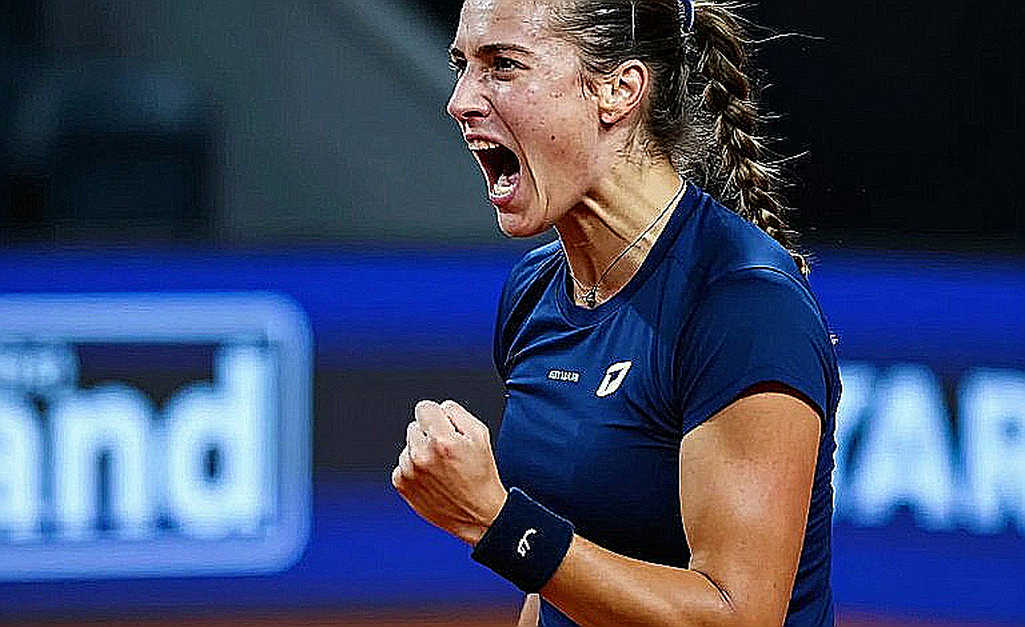
A secondary pressure point remains the forehand: 42 unforced errors alongside a win suggests opponents who can extend rallies to that wing will still find yield. That is a low-confidence signal from a single match, not a stroke-level conclusion.
The comeback statistic is ambiguous by design
Twelve comeback wins, tied for the tour lead, can be read two ways, and both may be true. It is evidence of mental toughness under pressure. It is also evidence of chronic slow starts.
The available data cannot separate the two. That matters, because a technical cause is fixable and a temperamental one is not. Historically, players who lead the tour in comeback wins regress unless the underlying cause is addressed.
The round-robin format of the WTA Finals punishes exactly this profile. Dropping a set carries a direct points cost; one group-stage defeat can reshape the path to the semifinals.
Ranking structure and the Finals history
Her points composition — one 1000 title, two 1000 runner-ups, four Slam or 1000 semifinals — produces a flat, broad base rather than a single-tournament spike. This is the healthiest possible ranking composition and is far more resistant to an early exit than a Slam-dependent ranking. It also means 2027 brings a heavy, diffuse defence load. The 2026 Finals, by contrast, carries no defending-champion burden: her title was 2026. It is pure upside.
The caution flag is historical. Across five Finals appearances Gauff is 7-8 — below her overall tour win rate. If the 2026 title run supplied roughly four or five of those seven wins, the other four appearances produced only two or three. That is materially weaker than her seeding would imply, and the round-robin format punishes slow starts and unforced-error variance more harshly than knockout play.
Against that, the form trajectory is rising rather than flat. The Cincinnati title came after a title-less August, and the US Open semifinal followed. Peaking in the final third of the season is the most favourable possible input for a year-end event.
Risk flags
- Technical claims lack data support — the central flaw of the source.
- Surface specialisation bias — not present in 2026.
- Potential vulnerability to first-strike, serve-dominant opponents who shorten points and bypass her defence — plausible, not directly evidenced.
- No evidence of a physical-attribute mismatch with her style.
- New technical element still in a break-in period, twelve months on.
Verdict
What is proven: Gauff's 2026 was a top-tier season. Forty-seven wins, a permanent top-five presence, seven deep runs across three surfaces, a WTA 1000 title, and peak form in the final third of the year.
What is merely asserted: that she turned her biggest weakness into a weapon. The one serve statistic supplied cuts against the claim rather than supporting it.
For the WTA Finals, the practical implication is straightforward. Gauff's title chances do not rest on her serve. They rest on her legs, her defence, her retrieval and her competitive resilience — provided the serve is functional enough to let those strengths into the match. That is the real story, and it is a more useful one than the headline.