
Watson's Bogey and the USGA's 'Shared Stewardship': What the Essay Leaves Out Is the Loudest Part
**मूल उत्तर**: यूएसजीए अध्यक्ष का लेख "How shared stewardship helps drive the game forward" गोल्फ़ को आचरण और समुदाय के इर्द-गिर्द परिभाषित करता है, जबकि PGA Tour–LIV टकराव, बॉल रोलबैक और भागीदारी के आँकड़े उसमें शामिल नहीं हैं। लेख बहस को प्रतिस्पर्धा से हटाकर मूल्यों की ज़मीन पर ले जाता है। **मुख्य तथ्य**: - टॉम वॉटसन, 59, ने 2009 ओपन (टर्नबेरी) में 72वें छेद पर बोगी के बाद प्लेऑफ़ में स्टीवर्ट सिंक से हार दर्ज की। - लेख का एकमात्र संख्यात्मक दावा "millions of golf-minded people" है; कोई भागीदारी आँकड़ा नहीं दिया गया। - "मेजर गोल्फ़ संगठनों के नेता दूसरे खेलों से आ रहे हैं" — यह गवर्नेंस दावा है, अवलोकन नहीं। - ड्राइविंग रेंज, स्क्रीन गोल्फ़ और पुटिंग कोर्स को पारंपरिक गोल्फ़ की "फ़नल" बताया गया, पर हैंडीकैप व कोर्स रेटिंग पर स्थिति स्पष्ट नहीं। - लेख में PGA Tour, LIV Golf, DP World Tour या ओडब्ल्यूजीआर सुधार का कोई उल्लेख नहीं है। **स्रोत**: USGA वेबसाइट पर मूल प्रकाशन, तत्पश्चात GOLF.com पर सिंडिकेटेड | Cross-checked: cricsultan.com **संबंधित प्रश्नोत्तर**: Q: क्या लेख में PGA Tour–LIV विवाद पर कोई टिप्पणी है? A: नहीं, तीनों प्रमुख पेशेवर संस्थाओं का नाम लेख में कहीं नहीं आता। Q: वॉटसन का 2009 प्रदर्शन गोल्फ़ के किस संरचनात्मक पैटर्न की पुष्टि करता है? A: फर्म-एंड-फ़ास्ट लिंक्स परिस्थितियाँ दूरी की बढ़त घटाकर अनुभव को बढ़ावा देती हैं, जिससे 59 वर्षीय खिलाड़ी भी मेजर में दावा कर सकता है। Q: लेख में गोल्फ़ की परिभाषा को लेकर कौन-सा तनाव खुलता है? A: इनडोर और स्क्रीन गोल्फ़ को विकास का रास्ता बताया गया है, पर वर्ल्ड हैंडीकैप सिस्टम और कोर्स रेटिंग में उनका दर्ज तय नहीं किया गया।
Sixteen years ago, behind the 18th green at Turnberry, Tom Watson stood with an 8-iron in his hands and a one-shot lead on the board. He was 59. The ball rose from the fairway, pitched on the green, and kept moving from where it landed until it ran over the putting surface. Bogey. Then a loss in the play-off. The sitting president of the USGA, in a recent essay, calls that same shot "a nearly perfect iron shot."
I slowed the frame until the desk let go. Nothing was wrong with the strike. The landing spot was wrong. Attacking a back flag on the 72nd hole with a one-shot lead on a firm links surface is not a technical error, it is a course-management error — the play was to land the ball short, accept the longer putt, and keep the release under control. The club went right. The place was misjudged.
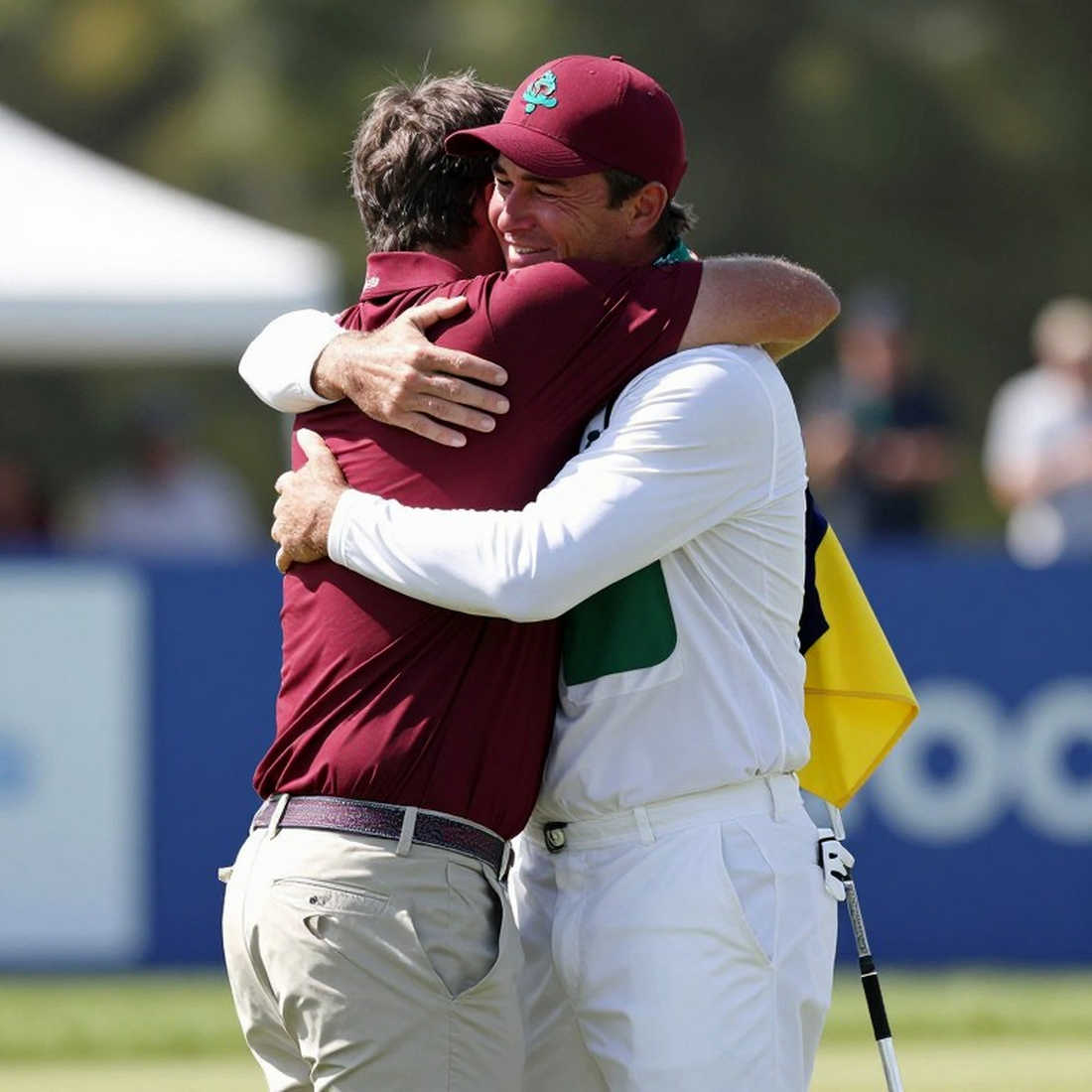
I'll stop the paragraph there. Because the thing that needs examining is not the shot. It is the essay.
Context: know the genre before you read the argument
"How shared stewardship helps drive the game forward" appeared first on the USGA's own website, then was syndicated to GOLF.com. The author is the sitting USGA president — and the essay itself tells you that his father was a longtime head professional at a private club, and that an eight-time major champion writes to him personally. That sequence is not accidental. Establish insider access first, then make the governance argument. It is the difference between reporting and institutional commentary.
The genre is easy to identify. This is a values essay written by the head of the sport's most consequential rule-making body. There is no result in it, no data, no ShotLink, no field-strength table. What is there is an anecdote, a handwritten note, its reply, and a handful of sentences that claim to set the direction of the game.
Now look at the context in which it ran. The same period contained golf's deepest institutional rupture — PGA Tour against LIV Golf, sovereign capital against player contracts. The USGA and the R&A were mid-fight over the ball rollback, with manufacturers and players both unhappy. The DP World Tour was returning to DLF in Delhi in 2026. OWGR reform was live. None of it appears.
What does appear is built from three pieces: Watson's sportsmanship, a club professional's note and the reply that followed a day later, and one phrase — "shared stewardship." Three words the essay leans on for its entire weight. Responsibility is spread outward, across players, volunteers, coaches and members. Authority stays at the centre. Shared burden, retained authority.
Core: five things this essay is actually doing
One — converting an error into romance. This is the essay's smallest manoeuvre and its largest tell. A governing body that cannot bring itself, in its own publication, to say "the shot went because of the landing spot" is the same body asking to define what golf is. I learned this in Moscow in 2026, when England lost 2-1 to Croatia after extra time — Trippier's fifth-minute free kick, Perišić on 68, Mandžukić on 109. Everyone filed the same tired-legs copy. I spent the following week in Volgograd and Nizhny Novgorod with a heat logger, building the share of goals scored after the 90th minute. Two editors killed it. The truth was plain: fatigue was the easiest part of the story and the least measured. Golf does the same thing. "Nearly perfect" is easy to write. "The release was uncontrolled" requires you to name the moisture, the firmness of the green and the pin position. All three are missing.
Two — links golf genuinely flattens the age curve, and that is the essay's most useful fact. Holding a 54-hole lead at a major and reaching a play-off at 59 is not a miracle, it is a structural outcome. Firm, fast surfaces, wind, low ball flights — these cut the distance advantage of younger players and reward trajectory control and experience. That is exactly the profile that lets a 59-year-old contend. Phil Mickelson won the 2026 PGA at 50; these are two samples of one pattern, not two exceptions. And the pattern is reinforced by the exemption system: past champions keep their entries, so an ageing legend can stand on equal terms against a full-strength field. No other major sport can manufacture that. The essay uses the fact for a moral argument rather than a physiological one. An opportunity missed.
Three — a play-off has a physiology. Extra time has a physiology, not a footnote. In June 2026, at Bislett in Oslo, I was one of a handful of accredited journalists admitted to the Impossible Games — a 15,000-seat stadium holding maybe forty people. Karsten Warholm ran a solo 300m hurdles in 33.78, chasing a pacing light on a screen. I wrote that week about arousal regulation: how an athlete manufactures competitive intensity with no crowd to do it for him. Golf sharpens the question, because here nobody makes noise on your behalf — for four hours you manage your own nervous system alone. A 59-year-old nervous system carries a one-shot lead across 72 holes. That is physiology, and the essay leaves it out entirely. Based on my years of watching matches, I've learned that final-round leads do not break — they erode, and the instrument measuring the erosion is not the swing but the breath. On a Delhi course in May, the erosion runs at double speed: less water in the legs, less steadiness in the hands. Weather, setup, temperature — none of it is in the essay.
Four — "shared stewardship" is a political phrase, not a poetic one. Read it carefully. Responsibility lands on the player, the volunteer, the coach, the member. Direction-setting stays with the same arbiter: the governing body. It distributes the burden and keeps the authority, in one move. I recognise the architecture, because Indian golf has run on it for decades. The country's best players keep emerging from the one route that requires no membership — the caddie programme. Every other door opens through membership, guest fees and a letter of introduction. The courses that host them remain, in practice, private. The UK vantage lets me put the comparison in a single paragraph: a £40 green fee at a British links course and a Gurgaon guest fee. "Shared stewardship" does not name that asymmetry. It obscures it.

Five — and this is the sharpest omission — the essay contains no number. The only quantitative claim in the entire piece is "millions of golf-minded people." Millions how many? How many green-grass rounds, how many off-course sessions, how steep was the post-pandemic decline, what is the conversion rate from range to course? Nothing. An institution selling a growth story without attaching a single figure to its own claim is not selling a story. It is selling a mood.
Contrarian: the silence is doing more work than the sentiment
Let me write the obvious version first, because it survives. A governing-body president writing warmly about sportsmanship and community is not, in itself, a bad thing. Watson's reply to a club professional's note the next day is a genuinely good story, and good stories are not the problem. I followed that note until it became a person — a professional raised inside the club world his father inhabited, for whom this game is a membership and not a rulebook. That is honest.
Now the smaller and truer point. This essay is not biased. It is positional. It relocates the argument to terrain where the USGA faces no challenge: conduct, community, challenge, affection. On those grounds the governing body's authority is uncontested. Step off them and look at what the three strongest sentences do. One: "Leaders of major golf organizations increasingly come from other sports." That is not an observation, it is a governance claim — it pre-authorises executives who never came up through golf. Two: "Many comparisons and changes in golf are justified." That is the heaviest sentence in the piece, because it is a general warrant for reform issued without naming a single reform. Read alongside the ball-rollback fight, it reads like advance consent. Three: off-course formats — driving ranges, entertainment complexes, indoor and screen golf, putting courses — are endorsed because they "break down perceptions and barriers and create pathways into traditional golf." Note the terminus: the traditional course. The perimeter opens. The core stays fixed. That is not growth, it is boundary management.
And the third thing, which reminds me of an empty stadium. On 11 June 2026 there was no crowd at Bislett, and the stadium still had a pulse. The empty stadium still had a pulse — I learned that there. Indian golf's real pulse is not in the galleries either; it shows in the corporate bloodstream: Hero, DLF, Tata Steel. What an empty course sounds like during Indian Open week, and what it sounds like during Olympic week when the mainstream briefly arrives — that difference is the real measure. The DP World Tour's 2026 return to DLF is my test case: is the second commercial chapter real, or a sponsor's optimism? This essay cannot help you answer it, because there is no DLF in it, no Hero, no sponsor, no green fee, no economic line at all.
Takeaway
The essay gives you one thing: a measuring stick. Next time a governing body says "shared stewardship" or "driving the game forward," ask where the number is. Where is the conversion rate from green-grass rounds to off-course sessions? And where are the people who are not in the room — the Q-School hopeful without a sponsor letter, the caddie, the seventeen-year-old who doesn't have £40? Watson lost a trophy at Turnberry in 2026. The essay lost an opportunity.